
Choosing the best Fire Rated MDF starts with the room, the tested assembly, and the evidence behind the product. A board that performs well in a dry office may not suit a busy corridor or a humid service area. Thickness, finish, fixing method, joints, and edge treatment can all affect the result. The red core alone proves very little.
For this introduction, composite technical specialist Daniel Mercer offers a practical reminder: “Choose the tested panel system, not just the fire-rated board.” His point is simple: check the product’s declared performance and test documentation, then confirm that the proposed installation matches them. Look closely at the board’s intended use, surface finish, and compatibility with doors, partitions, or wall linings. Small details matter. A cut edge left exposed can change the specification you thought you were buying.
There is no single best type for every project. Fire-rated MDF products differ in thickness, fire-performance classification, moisture suitability, and finish options. Ask suppliers for current technical sheets, installation guidance, and evidence relevant to the intended application. Compare complete systems, not just price per sheet. That shortcut can mislead. Labels can confuse, too, especially when product names sound similar. This guide will explain what to compare, where trade-offs appear, and which questions help narrow the choice. Even careful selection has limits: the right panel still depends on correct detailing and installation.
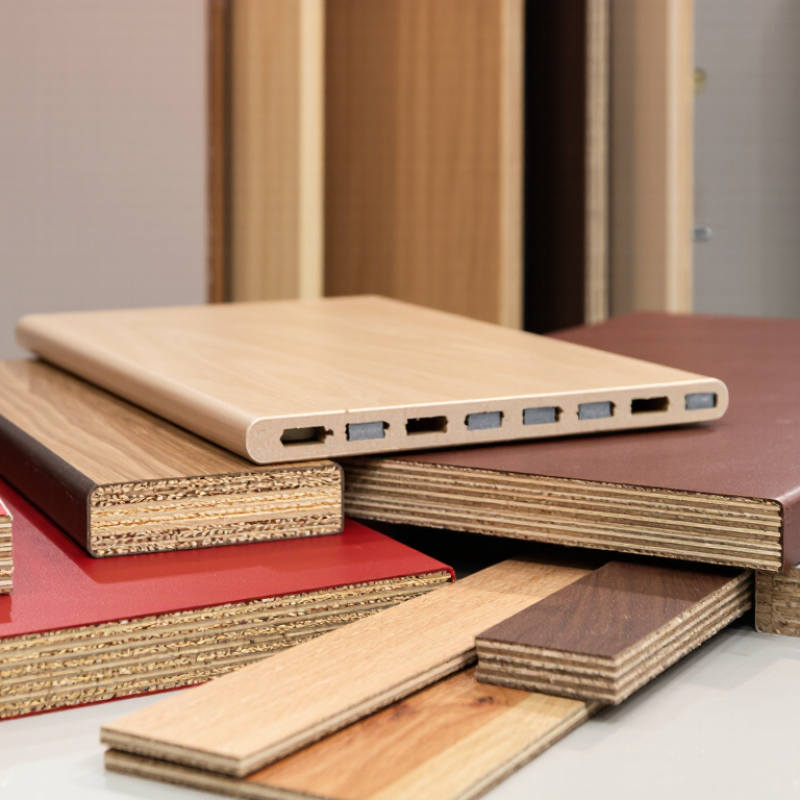
Fire-rated MDF is not simply standard MDF with a different label. It is made with fire-retardant additives and tested for specific fire-performance properties. Standard MDF does not offer that documented performance unless its product data says otherwise. The difference matters when a wall, door, or fitted panel must meet a project specification. Still, “fire-rated” does not mean fireproof. The board can char, weaken, and eventually burn under severe heat.
FR grades are not one universal scale. Names and ratings vary by region and product, so compare the stated test results rather than relying on a grade label alone. Check the technical data sheet for the classification, thickness, and intended use. Also confirm whether the rating applies to the board by itself or to a complete tested assembly, such as a wall with specified joints and fixings. Details count. A panel cut on site may expose untreated edges, and coatings or installation choices can affect performance. Check the paperwork. For a real project, match the board’s documented rating to the designer’s specification and ask a qualified supplier or building professional to clarify any gaps.
What Is the Best Type of Fire Rated MDF? The answer depends on where the panel will be installed and which test standard the project requires. EN 13501-1 classifies a product’s reaction to fire, including flame spread, smoke production, and flaming droplets. A classification such as B-s1,d0 indicates limited contribution to fire, low smoke, and no flaming droplets under the relevant test conditions. Check the complete classification, not just the letter.
ASTM E84 measures surface flame spread and smoke-developed indices in a tunnel test. In common specifications, Class A corresponds to a flame-spread index of 0–25; the smoke-developed index is reported separately, often with a limit of 450. This is not a fire-resistance rating. It does not tell you how long a wall or door assembly will resist fire.
The figures are not interchangeable. A panel tested to EN 13501-1 cannot automatically be treated as meeting an ASTM E84 requirement. Ask for the test report and confirm the tested thickness, mounting method, substrate, and intended use. A thin sample fixed directly to a non-combustible backing may behave differently from a thicker sheet installed over battens. Details matter. I would also check whether the report covers the exact product variant; small changes in density or finish can affect performance.
When comparing fire-rated MDF, read the ASTM E84 result rather than relying on “Class A” alone. Under common classifications, Class A means a Flame-Spread Index (FSI) of 0–25. The index describes how flame spreads across a tested surface under specific conditions. It does not show how long a wall or door can resist fire. Not a fire-resistance rating.
ASTM E84 reports a Smoke-Developed Index (SDI) separately from FSI. Check both values in the test report, along with the exact product description and test setup. A panel’s thickness, surface finish, mounting method, or air gap may affect whether the tested configuration matches your project. A different finish can matter.
Look for evidence that the report covers the MDF you plan to install, not simply a similar-looking panel. Confirm the tested face and whether coatings or laminates were included. If the document only says “Class A,” ask for the underlying test results. The label is useful, but it can feel more definitive than it is; that is worth pausing over. For a real installation, have the specification checked against applicable project requirements.
How to read Class A: Flame-Spread Index 0–25 under ASTM E84
Under commonly used building-code classifications, Class A corresponds to a Flame-Spread Index (FSI) of 0–25; Class B is 26–75, and Class C is 76–200. ASTM E84 measures surface-burning characteristics—it does not establish a fire-resistance rating in minutes. Check the product’s test documentation and applicable code requirements before specifying fire-retardant MDF.
Fire-rated MDF is not one universally “best” board. Choose a product tested at the required thickness and in the intended wall, door, or ceiling assembly. Thickness affects heat penetration and charring, while joints, fixings, backing layers, and air gaps can change performance. ASTM E84 test reports give flame-spread and smoke-developed indices for exposed surfaces. Under common building-code criteria, Class A means a flame-spread index of 0–25 and a smoke-developed index of 450 or less. These figures describe surface burning, not a one-hour fire-resistance rating. Easy to confuse.
For an assembly rating, check the fire-test report against the full specification: board thickness, layers, framing, insulation, fastener spacing, edge treatment, and orientation. ASTM E119 or UL 263 ratings apply to tested constructions; changing the board thickness or cavity may put the assembly outside the tested scope. Look for the test method, minutes achieved, permitted field of application, and production tolerances. A higher number on a datasheet alone proves little. In practice, the best MDF is the one whose tested configuration matches the drawings and site details. Even small gaps matter.
The best fire-rated MDF depends on where it will be installed, not just its rating. A panel for a wall lining may not be suitable for a door, cabinet, or ceiling. Check the product’s tested use, thickness, and installation instructions. A rating on its own is not enough.
Match the board to the actual end use. For a corridor wall, confirm whether the specification covers the board, joints, fixings, and any decorative finish. Paint or veneer can affect performance. Check the whole assembly. Ask for current test reports and certification that identify the product and intended application; don’t rely only on a sales description. Small details matter, such as an unsealed cut edge or a different screw spacing.
Then compare those documents with local building code and the project’s required fire performance. Requirements can vary by building type and location, so confirm them with the responsible design professional or authority. FR MDF is not automatically non-combustible, and it cannot replace a required tested system. It is tempting to choose the highest-looking rating and move on. That shortcut deserves a second thought. Verify availability, approved finishes, and installation guidance before ordering.
| End Use | FR MDF Type to Consider | Key Performance Priorities | Evidence to Request | Code and Specification Checks |
|---|---|---|---|---|
| Decorative wall panels and feature walls | Interior-grade fire-retardant MDF with a tested surface finish or documented compatibility with the intended finish | Reaction-to-fire classification, smoke production, finish compatibility, and appearance | Product-specific classification report and installation instructions covering the panel, finish, substrate, and fixing method | Confirm the required reaction-to-fire class for the room and building type. A panel’s classification may not apply after adding an untested finish. |
| Commercial partitions and wall linings | FR MDF specified as part of the complete wall or lining system | Required fire performance of the whole construction, joint details, cavity conditions, and fixing method | Test or assessment documents for the complete assembly, including the supporting construction and installation details | Where a fire-resistance period is required, verify the tested or approved assembly. A reaction-to-fire rating for a board alone does not establish a fire-resistance period. |
| Joinery in public or commercial interiors | FR MDF suitable for the intended interior application and the specified edge, coating, or laminate treatment | Reaction to fire, surface-finish performance, machinability, and any applicable emissions requirements | Current product data, fire classification documentation, and written confirmation of any restrictions on coatings or laminates | Check local requirements for the specific occupancy and location. Do not assume that one classification applies to every finish or installation. |
| Ceilings and overhead panels | FR MDF documented for the intended ceiling application and mounting arrangement | Reaction to fire, panel thickness, support spacing, fixing details, and overhead-use suitability | Installation instructions and test or assessment evidence that match the proposed orientation, support, and finish | Verify ceiling-specific requirements and any restrictions on cavities or suspended systems. Use only the documented fixing and support arrangement. |
| Areas where moisture may be present | An FR MDF product specifically documented for the expected humidity conditions, if available | Moisture suitability, dimensional stability, edge protection, and fire performance after any applied treatment or finish | Manufacturer’s declared service conditions and product-specific fire documentation | Fire-retardant treatment does not automatically make MDF moisture-resistant or suitable for exterior use. Confirm both properties independently. |
| Projects requiring a named national or regional classification | A product with documentation issued or accepted under the applicable local system | Classification method, test scope, permitted end uses, and validity of supporting documentation | For European projects, check the product’s declared reaction-to-fire classification under EN 13501-1 and relevant product documentation. For US projects, check applicable ASTM E84 test data and code acceptance. | Standards are not interchangeable: an EN classification and an ASTM E84 result cannot be directly converted into one another. Confirm acceptance with the project specifier or authority having jurisdiction. |
| Applications needing a specified fire-resistance duration | FR MDF only when included in a tested or approved fire-resistance-rated assembly | Assembly rating, construction details, penetrations, joints, and approved substitutions | Assembly-level test or listing documentation, such as evidence based on ASTM E119 or UL 263 where applicable | A fire-retardant MDF panel is not automatically fire-resistance-rated. The required duration applies to the complete assembly, not simply to the board material. |
| Any project before purchase | Select by documented end use rather than by the label “fire rated” alone | Exact product, thickness, finish, installation method, and intended location | Current technical data, test reports or classification documents, installation instructions, and any required declaration or third-party certification | Ask the local building official or project fire consultant to confirm the applicable code edition, required performance, and whether the submitted evidence is acceptable. |
476 Main Street - Route 28
Dennisport, MA 02639
Share On: