Top 10 Surface Mounted Lights for Home and Office
A Surface Mounted Light can solve a practical problem without demanding a deep ceiling cavity. It attaches directly to the ceiling or wall, making it useful in apartments, renovated rooms, and offices with limited installation space. Yet a neat fixture does not guarantee comfortable light. Glare, uneven coverage, and the wrong color temperature can make a tidy room feel harsh.
Lighting designer Thomas E. Farin is often credited with the observation, “Light is the first element of design; without it, there is no color, form, or texture.” That principle matters when comparing surface-mounted fixtures. A low-profile disk may suit a hallway, while an adjustable spotlight can direct light onto a desk or kitchen counter. Small details matter. Check the fixture’s lumen output, color-rendering index, dimming compatibility, and mounting requirements. For bathrooms or covered outdoor areas, verify that its rating fits the location.
This guide presents ten options for home and office use, with attention to appearance and everyday performance. A bright product photo can hide glare; specifications and room conditions deserve equal attention. A fixture that looks perfect online may feel too cool above a warm wood desk. That is worth questioning. Consider ceiling height, task needs, existing switches, and whether the light will be used for hours at a time. The best choice is not always the most decorative one. It is the one that provides suitable, comfortable illumination in the space where it will actually be installed.
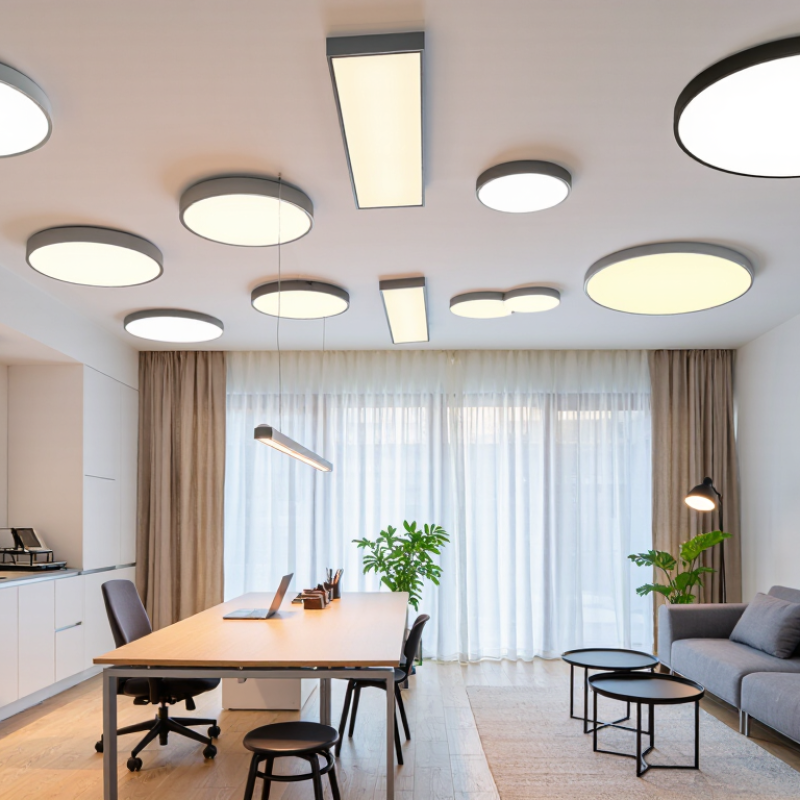
Define Surface-Mounted Lights: Flush, Semi-Flush, Panel, and Batten Types
Top 10 Surface Mounted Lights for Home and Office
Surface-mounted lights attach directly to a ceiling or wall, making them useful where recessed installation is impractical. Their shape affects glare, headroom, and how evenly light spreads. Flush mounts sit close to the ceiling, so they suit low rooms and narrow hallways. Semi-flush fixtures hang slightly lower, adding a visible detail while allowing more light to spread around the fitting. Not every room needs a decorative fixture.
Panel lights use broad, flat diffusers to deliver relatively even light across offices, kitchens, or work areas. Batten lights are long, narrow fittings that work well above benches, corridors, and utility spaces. Check the room’s ceiling height, task, and existing wiring before choosing. A bright panel can still feel harsh if it reflects on a screen.
LED versions can reduce operating costs. The U.S. Department of Energy’s Energy Saver guidance reports that LEDs use at least 75% less energy and last up to 25 times longer than incandescent lighting. These figures compare light sources, not fixture designs, so they do not guarantee equal results in every installation. I still find color and glare easy to underestimate. Check the product’s color temperature and diffuser in the actual room, if possible.
Compare 10 Surface-Mounted Lights for Home and Office by Form and Use
Surface-mounted lights suit rooms where a recessed ceiling is impractical, but their shapes affect more than appearance. A slim round disk keeps a hallway visually quiet; a square panel spreads light evenly across a compact office. A shallow drum shade softens a dining nook, while a globe adds a more decorative pool of light. Small rooms benefit. Check the fixture’s depth against doors, cabinets, and low ceilings before choosing.
For task lighting, a linear bar works well above a kitchen counter or desk, especially when its light is directed downward. An adjustable surface-mounted spotlight can highlight artwork or a reading chair, though one spot rarely lights an entire room evenly. A multi-head surface track offers flexible aiming, but its visible hardware can feel busy in a calm bedroom. A bowl-shaped fixture sends some light upward, which can make a ceiling feel brighter. It may still leave work surfaces dim.
Utility spaces call for different forms. A sealed, low-profile fixture is practical in a laundry room or covered entry, provided its damp-location rating matches the installation. A motion-sensing surface light can help in a pantry or garage, though sensor range and timing may need adjustment. For any of these ten types, compare brightness, color temperature, and dimmer compatibility—not just shape. A warm tone feels comfortable at home; a neutral tone can make desk tasks easier. The small print matters, and it is easy to overlook.
Plan Office Task Lighting Around the 500-Lux Standard for Desk Work
For many desk tasks, 500 lux is a commonly used target at the work surface, not a promise printed on a ceiling light. Lux measures illumination on a plane. Small distinction. It matters. A surface-mounted fixture can brighten a room while leaving papers in shadow, especially when placed far from the desk or behind the worker.
Plan fixtures around the desk layout. Aim for roughly 500 lux across the working zone, not in one bright spot. Check the desktop at several points with a lux meter after dark, with blinds in their usual position. A phone app gives only a rough comparison; its sensor and angle can skew readings. Keep direct light out of the eyes and off glossy screens.
A practical setup may pair evenly spaced surface-mounted lights with a dimmable desk lamp for close work. Adjust the lamp to avoid casting your writing-hand shadow across the page. The weak point in many plans is assuming one fixture suits every task. It may not. Recheck readings when desks move, partitions change, or daylight shifts, and consult local workplace guidance where required.
Surface-Mounted Office Lighting: Desk-Work Lux Targets
Desk-based writing, reading, and data processing commonly use a 500-lux maintained illuminance target. Use this as a planning benchmark when positioning surface-mounted lights; actual requirements depend on the applicable local lighting standard and project conditions.
Compare LED Efficiency: DOE Reports at Least 75% Less Energy Use
Surface-mounted lights sit close to the ceiling, making them useful in hallways, kitchens, and offices with limited headroom. When comparing models, check lumens and watts together. Lumens indicate light output; watts show electricity use. A higher lumen-per-watt figure means more light for each unit of energy.
The U.S. Department of Energy reports that LEDs use at least 75% less energy than incandescent lighting. That comparison is a helpful benchmark, not a guarantee that every LED fixture will cut every bill by the same amount. Compare fixtures that provide similar brightness, then consider hours of daily use. Numbers matter. A 1,600-lumen LED drawing 16 watts uses less power than an incandescent lamp producing comparable light. For a fair comparison, also check color temperature, dimmer compatibility, and whether the fixture’s light spreads evenly across the room. A bright spot over a desk can still leave the corners gloomy. I have found that product labels do not always make this easy to judge. If possible, review a room-scale lighting diagram or test the fixture before choosing several. A small mismatch becomes noticeable when repeated across a long corridor.
Top 10 Surface Mounted Lights for Home and Office - Compare LED Efficiency: DOE Reports at Least 75% Less Energy Use
Representative lighting scenarios for comparing surface-mounted LED options. Figures are planning estimates, not product ratings. | # | Surface-Mounted Light Type | Example Location | Target Output (lumens) | Estimated LED Load (W) | Incandescent Equivalent (W) | Estimated LED Use (kWh/year) | Estimated LED Cost (USD/year) | Estimated Energy Reduction |
| 1 | Compact flush-mount ceiling light | Small entryway | 800 | 8 | 53 | 8.76 | $1.40 | About 85% |
| 2 | Low-profile LED disk light | Closet or small office | 1,200 | 12 | 80 | 13.14 | $2.10 | About 85% |
| 3 | Decorative flush-mount fixture | Bedroom | 1,600 | 16 | 107 | 17.52 | $2.80 | About 85% |
| 4 | Surface-mounted linear batten | Kitchen or utility room | 2,000 | 20 | 133 | 21.90 | $3.50 | About 85% |
| 5 | LED wraparound fixture | Laundry room or corridor | 2,400 | 24 | 160 | 26.28 | $4.20 | About 85% |
| 6 | Surface-mounted panel light | Small office or meeting room | 3,000 | 30 | 200 | 32.85 | $5.26 | About 85% |
| 7 | Surface-mounted shop light | Workshop or garage | 3,600 | 36 | 240 | 39.42 | $6.31 | About 85% |
| 8 | Wide surface-mounted panel light | Open-plan office area | 4,500 | 45 | 300 | 49.28 | $7.88 | About 85% |
| 9 | High-output linear surface fixture | Large workshop or studio | 6,000 | 60 | 400 | 65.70 | $10.51 | About 85% |
| 10 | Large high-output surface fixture | Large shared workspace | 8,000 | 80 | 533 | 87.60 | $14.02 | About 85% |
Calculation assumptions: LED efficacy of 100 lumens per watt; incandescent comparison of 15 lumens per watt; operation for 3 hours per day; electricity price of $0.16 per kWh. Annual energy use = watts × 3 hours × 365 days ÷ 1,000. Costs and savings vary with actual fixture performance, usage, and local electricity rates. The U.S. Department of Energy states that LEDs use at least 75% less energy than incandescent lighting; the reduction shown here is calculated from the stated comparison assumptions. Source: U.S. Department of Energy, LED Lighting.
Check Color Quality, Dimming, IP Ratings, and Mounting Requirements
When comparing surface-mounted lights for a home or office, look beyond brightness. Color quality affects how paint, food, and skin appear. A color rendering index (CRI) of 90 or higher can help preserve natural-looking colors, especially in kitchens, bathrooms, and work areas. Check the light’s color temperature too: warm white can feel comfortable in a lounge, while a neutral tone often suits a desk. View samples in the actual room if possible. Walls can change the effect.
Dimming should be tested with the intended dimmer, not assumed from the packaging. Some LED fixtures flicker, buzz, or dim unevenly with incompatible controls. Annoying, but common. Ask whether the light supports smooth dimming across its full range, and check for a stated minimum level. A bright fixture that cannot dim low enough may feel harsh during evening use.
Check the IP rating against the location and likely exposure to moisture or dust. A bathroom ceiling near a shower needs different protection from a dry hallway; follow the fixture instructions and local installation guidance. Mounting requirements matter too. Measure the ceiling box, inspect available clearance, and confirm the fixture can cover old screw marks. Heavy lights may need secure support beyond a basic ceiling box. One detail is easy to miss: a shallow canopy may not sit flat over an uneven ceiling.

Share On: